Example 2: Best Management Practices for the Four Lake watershed
Background
When watersheds are impacted by nonpoint source pollution, the integration of the SWAT model with best management practices (BMPs) has proven to be a reliable and effective tool. This example refers to the article(Long et al, 2025).
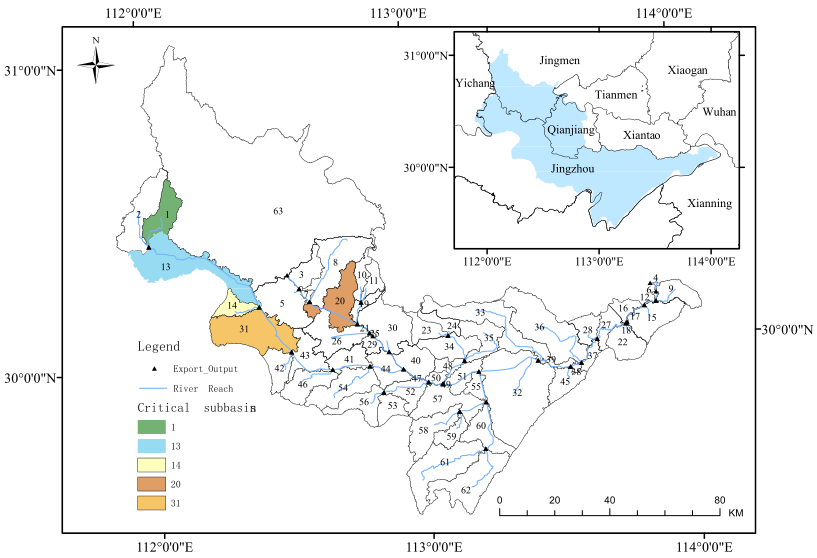
Information about Four Lake watershed
The Four Lake watershed locates in the middle reaches of the Yangtze River and the hinterland of the Jianghan Plain. For studying the transportation of water quality in this watershed, we build the SWAT model first. The data set used includes:
- DEM - The ASTER GDEM with a spatial resolution of 30 meters
- Land Use - The CNLUCC (China Land-Use/Cover Change) dataset
- Soil Data - The Second National Land Survey of Nanjing Soil Institute 1:1 million Soil Counts
- Meteorological Data - Regional Surface Meteorological Factor-Driven Dataset for China
- Runoff Observation - Runoff of Hydrographic Yearbook. (2008.1.1 to 2021.12.31)
- Water Quality Observation - China National Environmental Monitoring Center (2020.11 to 2021.12)
The calibration of runoff and water quality is omitted here, with a primary focus on the process of Best Management Practices (BMPs). In China, Total Nitrogen (TN) and Total Phosphorus (TP) concentrations are critical indicators for assessing lake water quality. The distributions of TN and TP in 2021.12.31 are show blew:
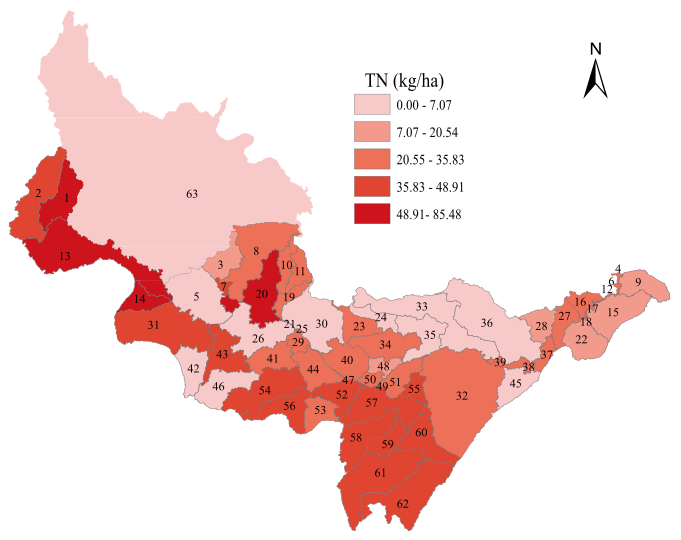
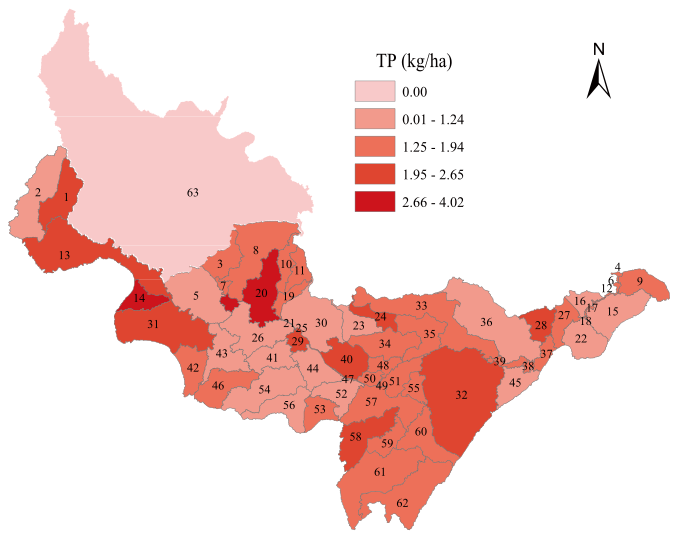
The distributions of TN and TP in the Four Lake basin
In the SWAT model applied in this study, the main lake is situated within sub-basin 32. Accordingly, particular attention should be directed toward sub-basin 51, which serves as the primary inflow region. Furthermore, management practices should be prioritized in the identified critical source areas, namely sub-basins 1, 13, 14, 20, and 31.
Optimization
In SWAT, there are many built-in BMPs, e.g., the terracing operation (BMP1), the tile drainage (BMP2) ... the filter strip (BMP4) ... the grassed waterways (BMP7).
For reduce TN and TP, the BMP4 and BMP7 are commonly utilized. Considering the cost, this example only focuses on the critical sub-basins like 1, 13, 14, 20, and 31.
The .ops files in SWAT project control and set BMPs to simulated the watershed. The parameters involving the filter strip are:
- FILTER_I: Indicator for filter strip simulation (1 for active, 0 for inactive).
- FILTER_RATIO: The ratio of field area to filter strip area (ha/ha). Range: 0–300.
- FILTER_CON: Fraction of the HRU area where 10% is densely vegetated and evenly distributed along the filter strip. This 10% area can intercept 25–75% of surface runoff.
- FILTER_CH: Fraction of the 10% dense area occupied by fully channelized flow (dimensionless). Fully channelized flow is not filtered by the strip.
The parameters about grassed waterways are:
- GWATI: Indicator for vegetative channel simulation (1 for active, 0 for inactive).
- GWATN: Manning's roughness coefficient for overland flow within the vegetative channel.
- GWATSPCON: Linear parameter for calculating sediment transport capacity in the vegetative channel.
- GWATD: Depth of the vegetative channel (m). If not specified, it is set to 3/64 of GWATW.
- GWATW: Average width of the vegetative channel (m).
- GWATL: Length of the vegetative channel (km).
- GWATS: Average slope of the vegetative channel (m/m).
To simplify the setting of BMPs, this example only optimize five parameters for a sub-basin, i.e., FILTER_I, FILTER_RATIO, GWATI, GWATW, and GWATL, resulting in a total of 25 variables. In addition, the optimization objectives including the reduction of TN and TP loads, as well as the costs associated with these BMPs. Therefore, this example is a multi-objective optimization problem involving a mixture of parameters.
The key information (variable types and ranges) of optimization parameters can be concluded as follows:
| Name | Type | Range | Unit |
|---|---|---|---|
| FILTER_I | int | 0-1 | none |
| FILTER_RATIO | float | 1-300 | none |
| GWATI | int | 0-1 | none |
| GWATW | discrete | 1, 5, 10, 15, 20, 25, 30 | m |
| GWATL | float | 10-1000 | km |
The first step is to prepare the parameter files. In contrast to Example 1, the BMP parameters differ among sub-basins. Consequently, each sub-basin requires an independent definition of all relevant parameters. In addition, the discrete parameter GWATW represents all possible values in the 'Min_Max' field by linking them with an underscore ('_'):
GWATW v d 1_5_10_15_20_25_30 1
The complete parameter file is:
File name : para_bmp.par
Name Mode Type Min_Max Scope
FILTER_I v i 0_1 1
FILTER_RATIO v f 1_300 1
GWATI v i 0_1 1
GWATW v d 1_5_10_15_20_25_30 1
GWATL v f 10_1000 1
FILTER_I v i 0_1 13
FILTER_RATIO v f 1_300 13
GWATI v i 0_1 13
GWATW v d 1_5_10_15_20_25_30 13
GWATL v f 10_1000 13
FILTER_I v i 0_1 14
FILTER_RATIO v f 1_300 14
GWATI v i 0_1 14
GWATW v d 1_5_10_15_20_25_30 14
GWATL v f 10_1000 14
FILTER_I v i 0_1 20
FILTER_RATIO v f 1_300 20
GWATI v i 0_1 20
GWATW v d 1_5_10_15_20_25_30 20
GWATL v f 10_1000 20
FILTER_I v i 0_1 31
FILTER_RATIO v f 1_300 31
GWATI v i 0_1 31
GWATW v d 1_5_10_15_20_25_30 31
GWATL v f 10_1000 31
💡 Noted: This file supports parameters with the same name, as they are distinguished by their indices.
Before editing the evl file, three objectives should be introduced. The first objective is the reduction of TN:
Obj_1 = \left ( TN_{base} - TN_{now}\right ) / TN_{base}
where TN_{base} and TN_{now} denote the total amount of TN flowing out of the 51 sub-basin before and after the application of BMPs, respectively.
The second objective is the reduction of TP:
Obj_2 = \left ( TP_{base} - TP_{now}\right ) / TP_{base}
where TP_{base} and TP_{now} denote the total amount of TP flowing out of the 51 sub-basin before and after the implementation of BMPs, respectively.
The third objective is the cost of BMPs. The unit cost of filter strip is 420 Yuan/ha, while the grassed waterways is 200 Yuan/ha. Therefore, for a sub-basin, the cost is:
cost_{filter}^i = Area_{AGRI}^i*FILTER_{RATIO}*FILTER_I*420
cost_{gwat}^i = GWATW * GWATL/10*GWATI*200
Obj_3 = \sum{cost_{filter}^i + cost_{gwat}^i}, i\in \left \{ 1,13,14,20,31 \right \}
where Area_{AGRI} represents the area of agricultural land use.
In this example, the computation of the objectives cannot be performed solely using the *.eval file. However, the necessary data can be obtained from the file, after which the objFunc or conFunc can be defined manually by the user.
For the first two objectives, the total amounts of TN and TP flowing out of the sub-basin 51 during 2021 are required.
Therefore, the eval file can be:
File name : obj_bmp.evl
SER_1 : ID of series data
OBJ_1 : ID of objective function
WGT_1.0 : Weight of series combination
RCH_51 : ID of RCH, or SUB, or HRU
COL_42 : Extract Variable. The 'NUM' is differences with *.rch, *.sub, *.hru.
FUNC_7 : Func Type ( 1 - NSE, 2 - RMSE, 3 - PCC, 4 - Pbias, 5 - KGE, 6 - Mean, 7 - Sum, 8 - Max, 9 - Min )
2021.1.1 to 2021.12.31 :

SER_2 : ID of series data
OBJ_2 : ID of objective function
WGT_1.0 : Weight of series combination
RCH_51 : ID of RCH, or SUB, or HRU
COL_43 : Extract Variable. The 'NUM' is differences with *.rch, *.sub, *.hru.
FUNC_7 : Func Type ( 1 - NSE, 2 - RMSE, 3 - PCC, 4 - Pbias, 5 - KGE, 6 - Mean, 7 - Sum, 8 - Max, 9 - Min )
2021.1.1 to 2021.12.31 : Period for data extraction
Now, the userObjFunc can be implemented by:
# Define base total nitrogen (TN) and total phosphorus (TP) loads for normalization

TN_Base = 3.314e7  # Baseline total nitrogen load (unit depends on context)
TP_Base = 3.717e6  # Baseline total phosphorus load

# Define the list of Basin IDs where BMPs (Best Management Practices) are applied
Basins = [1, 13, 14, 20, 31]

def userObjFunc(attr):
    """
    User-defined objective function.

    Parameters:
    - attr: dict
        Contains input decision variables, objective values, constraint values,
        time series for objectives and constraints, and HRU (Hydrological Response Unit) information.

    Returns:
    - objs: np.ndarray
        Array containing computed objective values [obj_1, obj_2, obj_3].
    """

    objs = np.zeros(3)  # Initialize three objective values

    # Extract decision variables (not used directly here, kept for potential future needs)
    x = attr["x"]

    # Compute the first objective:
    # Relative reduction in TN load compared to baseline
    objs[0] = (TN_Base - attr['objs'][1]) / TN_Base

    # Compute the second objective:
    # Relative reduction in TP load compared to baseline
    objs[1] = (TP_Base - attr['objs'][2]) / TP_Base

    # Compute the third objective: Total cost of BMP implementations
    HRUInfosTable = attr["HRUInfos"]  # Extract HRU information table

    cost = 0  # Initialize total cost

    for i, ID in enumerate(Basins):
        # Calculate the total area of the sub-basin
        areas = np.sum(
            HRUInfosTable.loc[
                (HRUInfosTable.SUB_ID == ID),
                "Area"
            ].tolist()
        )

        # Extract BMP design parameters from decision variables
        filter_I = x[5 * i]       # Filter switch
        filter_ratio = x[5 * i + 1]  # Fraction of area treated by filter
        graw_I = x[5 * i + 2]     # Graw BMP switch
        graw_W = x[5 * i + 3]     # Graw BMP width
        graw_L = x[5 * i + 4]     # Graw BMP length

        # Calculate the cost of filter BMPs
        cost_filter = areas * filter_ratio * filter_I * 420  # unit cost: 420 Yuan/ha

        # Calculate the cost of Graw BMPs
        cost_graw = graw_W * graw_L * graw_I /10 * 200  # unit cost = 200 Yuan/ha

        # Accumulate total cost
        cost += cost_filter + cost_graw

    objs[2] = cost  # Assign total cost to the third objective

    return objs
Unitl now, all preparatory work has been completed, and the optimization process can be conducted.
import numpy as np
from swatuq import SWAT_UQ
from UQPyL.optimization.multi_objective import NSGAII

nInput = 25
nOutput = 3

projectPath = "E:\\BMPs\\TxtInOut" # SWAT Project Path
exeName = "swat.exe" # Name of swat execute program in SWAT Project Path
workPath = "E:\\DJ_FSB" # Work Path
paraFileName = "para_bmp.par" # Name of parameter file in Work Path
evalFileName = "obj_bmp.evl" # Name of evaluation file in Work Path
specialFileName = "special_paras1.txt" # Name of special parameter file in Work Path

problem = SWAT_UQ(projectPath = projectPath, swatExeName = exeName,
                  specialFileName = specialFileName, workPath = workPath,
                  paraFileName = paraFileName, evalFileName = evalFileName,
                  verboseFlag = True, numParallel = 10,
                  userObjFunc = userObjFunc, nOutput = 3,
                  optType = ["max", "max", "min"])

nsgaii = NSGAII(nPop = 100, maxFEs = 20000, saveFlag = True, verboseFlag = True, verboseFreq = 5)

nsgaii.run(problem = problem)

# The result would be save to `Result\Data\NSGAII_SWAT-UQ_D25_M3.hdf`
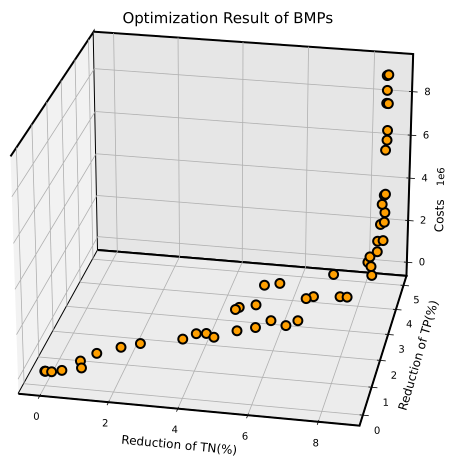
The visualization of BMP optimization shows below: